

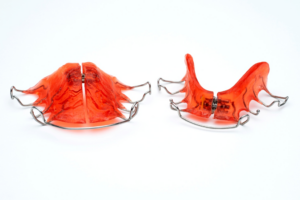
When most people think about orthodontic treatment, braces and clear aligners are the first things that come to mind. And while those options are certainly the most well-known, they’re far from the only tools an orthodontist has available! In fact, many patients benefit from specialized orthodontic appliances that work alongside or independently of traditional braces to address specific concerns. Here’s a closer look at three of the most commonly used orthodontic appliances you may not have heard of.
Retainers
If you or your child has completed orthodontic treatment, wearing a retainer is almost certainly the next part. After braces or aligners have moved the teeth into their ideal positions, the surrounding bone and tissues need time to stabilize and adapt to those new positions. Without a retainer, teeth have a natural tendency to drift back toward where they were before treatment.
There are two main types of retainers: removable and fixed. Removable retainers, which include both clear plastic aligners and traditional Hawley retainers, can be taken out for eating, brushing, and flossing. Fixed retainers, on the other hand, consist of a thin wire bonded to the back of the teeth and cannot be removed by the patient. It’s worth noting that wearing a retainer is typically a lifelong commitment, though how often you need to wear it tends to decrease over time.
Thumb Cribs
Thumb-sucking is a completely normal and comforting behavior for infants and toddlers, and most children naturally stop on their own by age 3 or 4. However, when the habit continues past that point, it can start to cause real orthodontic problems. Prolonged thumb-sucking can push the front teeth forward, create an open bite, and even affect the shape of the developing jaw.
A thumb crib is a small orthodontic appliance designed to help children break the thumb-sucking habit. When a child places their thumb in their mouth, the crib prevents them from creating the suction they’re used to, which takes away the comfort element that thumb-sucking provides.
Palatal Expanders
When the upper jaw is too narrow, it can lead to a range of problems, including crowding, crossbites, and even difficulty breathing through the nose. By gently expanding the palate, more space can be made for the permanent teeth to erupt properly.
A palatal expander is a device that gradually widens the upper jaw over a period of several months. It’s most commonly recommended for young children, since the palate’s development is much easier to influence earlier in life. Palatal expanders are fixed in place and adjusted gradually to apply gentle pressure that slowly separates the two halves of the palate. Over time, new bone fills in the space that’s created, making the wider arch permanent.
About the Practice
At Hanson Orthodontics of Allen, our team offers a full range of treatments, including orthodontic appliances such as retainers, palatal expanders, and thumb cribs, to help patients of all ages achieve healthier, more beautiful smiles. If you have any questions about the blog or you’re ready to schedule an appointment for yourself or a family member, you can call or reach out online for more information or assistance. Telephone: (972) 727-1153.